Portuguese Translation Service

We provide professional Portuguese translation services. Our certified and ISO-compliant services are ideal for companies entering markets in Brazil, Portugal, and other Portuguese-speaking countries. Our Portuguese translators are native speakers with many years of experience in providing quality translations for your projects. Actual Portuguese Translation from The Translation Company
We Translate English and Portuguese Documents
Hundreds of satisfied corporate clients in over 30 countries use our Portuguese translations. Our Quality Assurance Team has certified translators, dedicated project managers, and seasoned editors. These are some of the qualities our clients identify in our services:
|
|
|
How To Get Started
Free Quote
sales@thetranslationcompany.com
800.725.6498
#1 Contact us to get a free quote or questions answered, or
#2 Upload your files for an instant translation quote, or
#3 Schedule a free Zoom meeting with our team now.
Field-Specific Translators
Our professional Portuguese translators specialize in translating specific fields such as business, technology, law, marketing, and medical sciences. Translators increase the quality of their translations as they specialize in a certain field.
Special services: Sworn translations (aka “Tradução Juramentada”) and Rush Jobs.
Support services: desktop publishing and certified translations
 |
 |
| Premium Quality | Best price |
We guarantee the highest quality translations at competitive prices with short turnarounds. Our project managers, translators, and editors work together to provide you with the best document translation.
Portuguese Document Translation
The Translation Company is recognized as a leader in Portuguese to English and English to Portuguese translations. Some of the documents our Portuguese translators translate daily:
|
|
|
We use state-of-art translation tools, methodologies, and native linguists to increase productivity and quality. Count on our team to help you translate user manuals, legal documents, marketing brochures, and any type of documents to be used in Portuguese-speaking countries.
Certified Women’s Owned Business:

Country-targeting translations are available for the following countries: Portugal, Brazil, Mozambique, Angola, Guinea-Bissau, East Timor, Equatorial Guinea, Macau, Capo Verde, and Sao Tome and Principe.
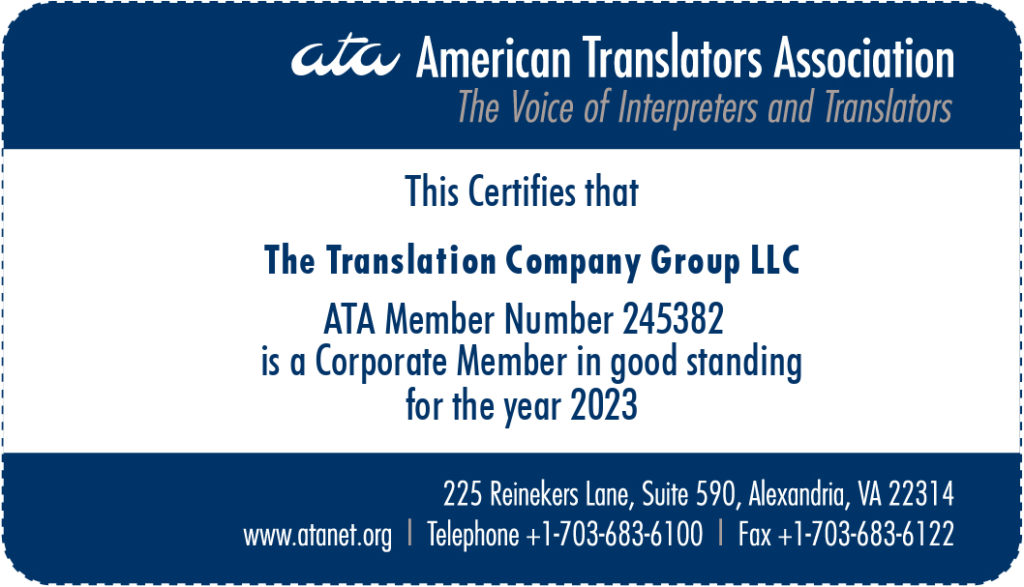
When you purchase from us, you rely on a company member of the American Translators Association:
How To Get Started
Free Quote
sales@thetranslationcompany.com
800.725.6498
#1 Contact us to get a free quote or questions answered, or
#2 Upload your files for an instant translation quote, or
#3 Schedule a free Zoom meeting with our team now.
Portuguese Language Quick Facts
Portuguese is the official language in nine nations. It ranks as the sixth most frequently spoken language.
- Over 200 million people speak Portuguese.
- Portuguese Translation is one of the top five languages translated.
- Portuguese is the official language of the European Union.
- Portuguese is classified into Brazilian Portuguese and European Portuguese
- Brazilian Portuguese is spoken in Brazil, while European Portuguese is adopted in other countries.
- Due to the economic power of Brazil, the demand for Portuguese translation services has been growing strongly.
Follow these Technical Tips for a Successful Project
To get a Portuguese translation properly done, consider the following factors:
- Brazilian Portuguese is different from European Portuguese. Spelling, vocabulary, and grammar are different.
- It is easy for native speakers to know when a document was not translated into the right variant.
- Professional Portuguese translators translate only into their native Portuguese variant.
- Brazilian translators translate into Brazilian Portuguese while European translators translate into European Portuguese.
- Many companies translate their documents solely into Brazilian Portuguese.
- Brazil has one of the top 10 GDPs in the world (almost ten times bigger than Portugal’s).
Get Your Quote Today – High-Quality Portuguese!
If you want to acquire customers in Brazil or Portugal, hire a Portuguese translation agency. Whether running an e-commerce store or an online service, providing information in Portuguese is a great way to increase your business. Portuguese translation offers you access to markets often overlooked by your competitors.
Portuguese is the sixth most spoken language, with over 200 million speakers worldwide. Two hundred million people is a large segment you could be reaching with Portuguese translations. It’s easier for a person to pay for something they understand in their native language.
Offering your website and marketing materials in Portuguese broadens your market considerably. Localized information makes your business more attractive to potential Portuguese speakers. Let us help you with your company’s expansion. We want your company to prosper whether you need European or Brazilian Portuguese translations!
How To Get Started
Free Quote
sales@thetranslationcompany.com
800.725.6498
#1 Contact us to get a free quote or questions answered, or
#2 Upload your files for an instant translation quote, or
#3 Schedule a free Zoom meeting with our team now.